
BingX vs Bybit: Which Is Better for Copy Trading in 2026?
BingX and Bybit are two of the most frequently compared exchanges for copy trading. Both platforms have built copy trading into their core product, both support a large pool of lead traders, and both operate as derivatives-focused centralized exchanges. For a trader trying to decide between the two in 2026, the differences are meaningful.
This article compares BingX and Bybit across copy trading mechanics, fees, KYC requirements, regulation, security history, and additional features. One relevant distinction from the outset: BingX is a TetherBack partner exchange, which means TetherBack-registered users on BingX receive 50% cashback on all trading fees, including fees generated by copy positions. Bybit is not a TetherBack partner.

Platform Overview
|
Feature |
BingX |
Bybit |
|
Founded |
2018 |
2018 |
|
Primary Focus |
Copy trading, grid bots, TradFi |
Derivatives, options, institutional products |
|
Copy Trading Providers |
120,000+ |
Large pool, curated leaderboard |
|
Min. Copy Investment |
$5 |
Tiered, varies by lead trader |
|
Copy Trading KYC |
Optional for basic access |
Required (Classic copy trading requires KYC) |
|
Profit-Share Model |
Fee-aligned model |
Profit-share starting at 10% of follower gains |
|
Lead Trader Metrics |
ROI, win rate, drawdown, period |
Verified 180-day P&L, drawdown, win rate, duration |
|
Grid Trading Bots |
Yes (spot, futures, infinity grid) |
Yes (grid and DCA bots) |
|
TradFi Perpetuals |
Yes (stocks, forex, commodities) |
No |
|
Max Futures Leverage |
Up to 150x on perpetuals |
Up to 100x (BTC); 125x on select USDC perps |
|
Regulation |
Singapore-based. No tier-1 license |
VARA licensed (Dubai). No major Western license. |
|
Security Incident |
Sep 2024 hack, $43M. Users repaid. |
Feb 2025 $1.4B ByBit hack. User funds covered. |
|
Proof of Reserves |
Monthly Merkle tree POR (100%) |
Published regularly |
|
TetherBack Partner |
Yes (50% cashback) |
No |

Copy Trading: Mechanics and Depth
BingX Copy Trading
BingX launched copy trading in 2019 and is widely recognized as one of the pioneers of the feature in crypto. The platform provides access to over 120,000 strategy providers, representing the largest raw provider pool in the industry. The minimum investment to follow a lead trader is $5, which is among the lowest entry thresholds available on any exchange.
Copy settings on BingX include investment amount, leverage mode, trading pairs, and a maximum loss threshold. As of February 2026, BingX also aligned copy trading fees with the follower's standard account fee rate rather than a separate profit-share structure. BingX has extended copy trading to its TradFi markets, meaning followers can now copy lead traders across traditional asset classes including stocks, forex, and commodity perpetuals.
Bybit Copy Trading
Bybit uses a profit-share model where followers pay a percentage of trading gains to the lead trader. Share rates begin at 10% for Cadet and Bronze level traders and increase at higher performance tiers. Bybit requires KYC verification for Classic copy trading access. The platform provides lead traders with verified 180-day performance windows including P&L, win rate, drawdown, and average trade duration, which offers a longer and more structured evaluation framework than many competitors.
Independent testing of Bybit's copy trading in 2026 has shown tracking error against lead traders within approximately 0.8% over a 14-day period across multiple lead traders, which is a strong execution result. Bybit's BTC-USDT perpetual contract carries $4 billion or more in open interest, giving copy positions deeper liquidity than most competing venues.
Fee Comparison
Standard futures fees on BingX are 0.02% maker and 0.05% taker. Bybit runs at 0.02% maker and 0.055% taker for standard futures accounts. The difference is minimal at standard rates. The significant cost divergence appears when TetherBack is factored in for BingX users.
|
Fee Type |
BingX Standard |
BingX via TetherBack |
Bybit Standard |
|
Futures Maker |
0.020% |
0.020% + 50% rebate = net 0.010% |
0.020% |
|
Futures Taker |
0.050% |
0.050% + 50% rebate = net 0.025% |
0.055% |
|
Spot Maker |
0.100% |
0.100% + 50% rebate = net 0.050% |
0.100% |
|
Spot Taker |
0.100% |
0.100% + 50% rebate = net 0.050% |
0.100% |
TetherBack-registered BingX users receive 50% cashback on all fees, reducing the effective taker cost to 0.025% versus Bybit's 0.055%. For high-frequency copy traders where positions are opened and closed repeatedly, that gap compounds materially over a month.
KYC and Access
BingX does not require KYC for basic copy trading access. Traders can follow lead traders without identity verification, though KYC unlocks higher withdrawal limits and full feature access. Bybit requires KYC to use Classic copy trading. For traders who prioritize access without verification friction, BingX has the clearer advantage.
Security and Regulatory Standing
Both platforms have experienced significant security incidents. BingX suffered a $43 to $52 million hot wallet breach in September 2024. All affected users were fully compensated, and BingX launched the ShieldX security program afterward. Bybit suffered a substantially larger breach in February 2025, losing approximately $1.4 billion primarily from a multisig wallet compromise attributed to the Lazarus Group. Bybit also covered affected user balances in full.
On the regulatory side, Bybit holds a VARA license in Dubai, which is a real regulatory credential from an active financial authority. BingX does not hold an equivalent confirmed tier-one license. Neither exchange is available in the United States. For traders in jurisdictions where regulatory backing is a meaningful criterion, Bybit has the stronger standing.
Which Platform Is Better for You?
BingX is the stronger choice if you are a beginner copy trader who wants the lowest entry barrier, if you want to copy trade with a small starting amount, if KYC is a concern, if you want to copy across TradFi assets as well as crypto, or if you are a TetherBack user looking to reduce the net fee cost of your copy positions through the 50% cashback program.
Bybit is the stronger choice if you want a more structured and curated copy trading environment with rigorous lead trader metrics, if deeper derivatives liquidity matters to your strategy, if regulatory backing is a priority, or if you intend to use additional products such as options or institutional-grade tools alongside copy trading.
Frequently Asked Questions
Which platform has more copy traders available, BingX or Bybit?
BingX offers access to over 120,000 strategy providers, making it the larger pool in terms of raw numbers. Bybit takes a more curated approach, with a structured leaderboard and verified 180-day performance metrics that can make comparative evaluation more straightforward.
What is the minimum investment to start copy trading on BingX versus Bybit?
BingX allows copy trading to begin with as little as $5, which is one of the lowest entry points in the industry. Bybit's minimum varies by lead trader and account tier, and is generally higher. For traders starting with small capital, BingX has a clear accessibility advantage.
Does BingX copy trading require KYC?
Basic copy trading access on BingX does not require KYC verification. Bybit's Classic copy trading system requires KYC to follow traders. This distinction matters for traders who prefer to avoid identity verification.
How does Bybit's profit-share model compare to BingX's copy trading fees?
Bybit uses a profit-share model where followers pay a percentage of trading gains to the lead trader, starting at 10% for Cadet and Bronze level traders. BingX aligns copy trading fees with the follower's standard account fee rate rather than a profit-share structure. Depending on your performance, one model may be more cost-efficient than the other.
Does either BingX or Bybit offer copy trading on non-crypto assets?
Yes, but only BingX. As of 2026, BingX has extended its copy trading feature to TradFi markets through BingX TradFi, allowing followers to copy lead traders across stocks, forex, and commodity perpetuals. Bybit does not offer this.
Which exchange is better regulated for copy trading?
Bybit holds a VARA license in Dubai, which represents a more established regulatory credential than BingX's current registration status. However, neither exchange holds a tier-one Western derivatives license (FCA, MAS, or CFTC). Bybit's regulatory standing is stronger on a comparative basis.
Can I earn TetherBack cashback on copy trades executed through BingX?
Yes. Copy trading on BingX generates trading fees on every position opened and closed. Since TetherBack's 50% cashback applies to fee-generating activity on your linked BingX account, fees from your copy positions count toward your daily rebate calculation. Bybit is not a TetherBack partner.
Glossary
-
Copy Trading: An automated feature replicating the live positions of a designated lead trader on the follower's account in real time.
-
Lead Trader: A user whose live trading positions are made available for others to automatically replicate.
-
Profit-Share Model: A copy trading fee structure where followers pay a percentage of their profits to the lead trader they are copying, as used on Bybit.
-
ROI: Return on Investment. A performance metric expressing profit or loss as a percentage of capital allocated over a defined period.
-
Drawdown: The peak-to-trough decline in a lead trader's account value, used to assess downside risk before following.
-
Win Rate: The percentage of closed trades finished in profit, used as one of several indicators when evaluating lead traders.
-
VARA: The Virtual Assets Regulatory Authority of Dubai. The regulatory body under which Bybit holds its primary exchange license.
-
TradFi Perpetuals: Perpetual futures contracts on traditional financial instruments such as stocks, forex, and commodities, offered through a crypto exchange infrastructure as on BingX.
-
Grid Trading Bot: An automated trading tool that places buy and sell orders at set price intervals within a defined range, profiting from price oscillation.
-
Funding Rate: A periodic payment exchanged between long and short perpetual futures holders to keep the contract price aligned with the spot market.
About TetherBack
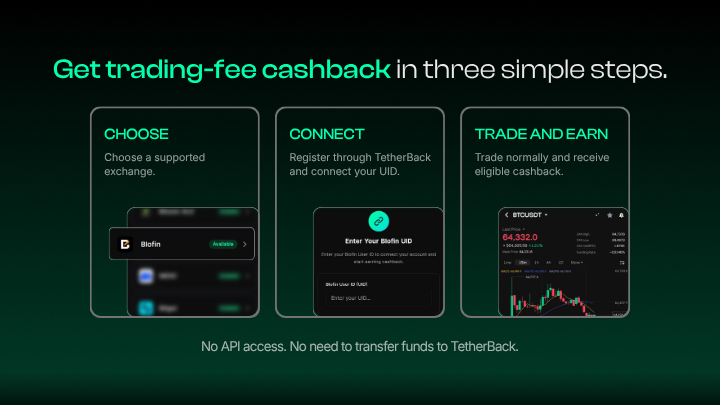
TetherBack is a crypto cashback and rewards platform built for active traders who want to reduce effective trading costs. By partnering with supported exchanges, TetherBack shares a portion of trading fee revenue back to users in the form of cashback.
The platform does not hold user funds and does not operate as an exchange. Traders continue to execute trades directly on their chosen exchange while earning rewards through the partnership structure.
TetherBack focuses on cost efficiency, transparency, and providing traders with a structured way to maximize value from their existing trading activity.