

How Leverage Works in Crypto Futures and Why It Increases Risk
Leverage is one of the most misunderstood parts of crypto futures trading. For beginners, it often sounds attractive because it allows a trader to open a larger position with less money upfront. But that same feature is exactly why leveraged crypto trading can become so risky so quickly.
In simple terms, leverage in crypto futures means borrowed exposure. Instead of using only your own capital to open a position, the platform lets you control a bigger position size with a smaller amount of margin. That can make gains look larger when the market moves your way, but it also means even a small move against your trade can create outsized losses.
This is why crypto leverage explained properly should always start with risk, not profit. Leverage is not a bonus. It is a force multiplier. It increases exposure, which means it increases both upside and downside. For beginners, that usually makes crypto futures more dangerous than they first appear.

What Is Leverage in Crypto Futures?
Leverage in crypto futures is the use of borrowed exposure to open a position that is larger than the amount of money you actually commit as collateral. In futures markets, that collateral is typically called margin. A trader might only post a small amount of funds, but the platform allows them to control a much bigger trade.
For example, if a platform offers 10x leverage, that means a trader can control a position ten times larger than their initial margin amount. If they put up $100, they may be able to open a $1,000 position. This is why futures leverage crypto products are often described as capital-efficient. But capital efficiency is only one side of the story. The other side is amplified loss.
That is the first thing beginners should understand. Leverage does not change the market. It changes how strongly the market affects your account.
How Leverage Works in Practice
A simple way to understand leveraged crypto trading is to compare it with an unleveraged trade.
If you buy $100 worth of Bitcoin in the spot market and Bitcoin rises 5%, your position gains about $5 in value. If Bitcoin falls 5%, your position loses about $5. Your gain or loss is directly tied to the amount you bought.
Now imagine you use 10x leverage in crypto futures. Instead of controlling a $100 position, you control a $1,000 position using $100 in margin. If the market rises 5%, the gain on that larger position is much bigger relative to your initial capital. But if the market falls 5%, the loss is also much bigger relative to your margin.
This is the heart of crypto leverage explained in simple terms. The market does not need to move very far for the effect on your account to become serious.
Why Leverage Increases Risk
Leverage increases risk because it makes every percentage move in the market more powerful against your margin balance. A trade that would feel manageable without leverage can become dangerous once the position size is magnified.
For beginners, this creates two major problems.
The first is speed. Losses can build much faster than expected. A trader may think the market only moved a little, but their leveraged position can already be under serious pressure.
The second is psychological pressure. Because outcomes are amplified, traders often react emotionally, close positions too late, or increase risk in an attempt to recover quickly. That combination of volatility and emotional decision-making is one reason leveraged crypto trading can be so unforgiving for beginners.

Margin: The Foundation of Leveraged Trading
To understand leverage in crypto futures, beginners also need to understand margin.
Margin is the collateral posted to support a leveraged trade. It is the money in the account that helps absorb losses. If your trade moves against you, the value of your margin effectively shrinks. If it falls below the platform’s required level, the position may be at risk.
This means leverage and margin are directly connected. The more leverage used, the smaller the margin cushion relative to the position size. That is why higher leverage usually means less room for error.
Liquidation: The Risk Beginners Fear Most
Liquidation is one of the most important reasons leverage in crypto futures is risky.
Liquidation happens when a trader’s position no longer meets the platform’s minimum margin requirement, so the exchange or platform automatically closes the position to prevent further losses.
This is very different from normal spot trading. In spot, an asset can fall and you still keep holding it unless you choose to sell. In futures, a leveraged position can be closed automatically before the market has any chance to recover. The higher the leverage, the less room the position usually has to survive short-term volatility.
That is why beginners should never think of leverage as just a way to make more money. It is also a faster path to liquidation if the trade goes the wrong way.
A Simple Example of Futures Leverage Crypto Traders Use
Imagine a trader opens a futures position with 10x leverage.
They place $200 in margin and open a $2,000 position. If the market moves up 3%, the position gains value faster than it would without leverage. But if the market moves down 3%, the loss also hits the trader’s $200 margin much more strongly.
Now imagine the trader had used no leverage and simply bought $200 worth of the asset in the spot market. That same 3% move would still matter, but it would have a much smaller effect on the account. This is why even modest leverage can significantly increase the intensity of a trade.
Crypto Leverage Explained With Perpetual Futures
Most crypto futures beginners encounter today are not traditional dated futures. They are perpetual futures, also called perpetual contracts or perps. These contracts do not have a fixed expiration date, so they rely on a funding mechanism to keep their market price close to the underlying spot price.
Leverage still works the same way in perpetuals: it increases position exposure relative to the posted margin. But perpetual contracts add another layer to risk because they also include funding payments.
For beginners, this means a leveraged crypto trade is not only about whether price goes up or down. Costs can matter too. A trader may be right on direction but still have results affected by fees and funding.
Why High Leverage Is Especially Dangerous for Beginners
High leverage is especially dangerous for beginners because it reduces the margin for error to a very small level. A normal market fluctuation can become a serious account event when the position size is too large relative to the trader’s capital.
Beginners also tend to make several predictable mistakes with leverage:
Using leverage before understanding margin
Some traders focus on the bigger position size and ignore the role of margin until the trade moves against them.
Treating leverage like free money
Leverage increases exposure. It does not create an advantage by itself.
Ignoring liquidation risk
A trader may think the market will recover eventually, but the position might be liquidated first.
Forgetting fees and funding
Leveraged positions can be more expensive to hold than beginners expect, especially in perpetual futures.
Spot Trading vs Leveraged Futures Trading
Comparing spot trading with leveraged futures trading helps make the risk difference clearer.
In spot trading, you buy the asset directly. Your gains and losses track the asset’s price based on the amount you purchased. There is no standard futures liquidation mechanism tied to leverage if you are just buying spot.
In leveraged futures trading, you are holding a contract rather than the asset itself, and the position size can be much larger than your margin. That makes the trade more flexible, but also much more sensitive to price changes. This is why beginner education generally treats spot trading as simpler and leveraged futures as more advanced and riskier.
How TetherBack Can Help Reduce Futures Trading Fee Pressure
Once a beginner understands how leverage works in crypto futures, the next practical issue is cost. Leveraged trading already increases risk, and repeated trading fees can add even more pressure over time. That matters especially for active futures traders.
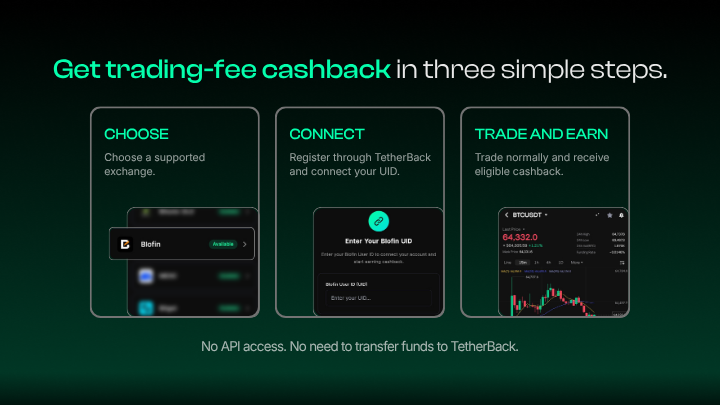
This is where TetherBack can help. Users start by signing up on TetherBack, choose a supported exchange through the TetherBack platform, register through that exchange link, and then connect their new UID back on TetherBack. When the setup is completed correctly, eligible trading activity can generate cashback on fees.
For leveraged crypto trading, that can help reduce part of the effective fee burden over time. It does not make leverage safer, and it does not remove liquidation risk. But it can help make trading costs more efficient for users who follow the correct TetherBack process and trade on supported partner exchanges.
Glossary
-
Leverage: A tool that lets traders control a larger position with a smaller amount of capital.
-
Margin: The collateral used to open and maintain a leveraged trade.
-
Liquidation: Forced closure of a position when the margin is no longer enough to support it.
-
Perpetual futures: Futures-style contracts with no fixed expiration date.
-
Funding rate: A periodic payment exchanged between long and short traders in perpetual futures.
-
Long position: A trade that benefits if the asset price rises.
-
Short position: A trade that benefits if the asset price falls.
-
Position size: The total value of the trade being controlled.
-
Collateral: Assets or funds posted to support a trade.
-
Volatility: How quickly and sharply market prices move.
-
Leveraged crypto trading: Trading crypto products with borrowed exposure rather than only your own capital.
-
UID: The account identifier used to connect an exchange account back to TetherBack.
FAQ
What is leverage in crypto futures?
Leverage in crypto futures lets a trader control a larger position with a smaller amount of margin. It increases both potential gains and potential losses.
Why is leverage risky?
Leverage is risky because it amplifies the effect of market moves on your account. Even a small move against your position can create a large loss relative to your margin.
What is margin in leveraged crypto trading?
Margin is the collateral posted to open and support a leveraged position. If losses reduce margin too much, the position may be at risk of liquidation.
What is liquidation?
Liquidation is the automatic closure of a leveraged position when margin requirements are no longer met.
Is higher leverage always better?
No. Higher leverage gives more exposure, but it also increases liquidation risk and reduces the room a trade has to survive volatility.
Do perpetual futures use leverage?
They can. Perpetual futures commonly allow leverage, and they also use funding rates to keep contract prices close to spot prices.
Can TetherBack reduce leveraged trading costs?
TetherBack can help eligible users reduce part of their trading fee costs through cashback when they sign up correctly through TetherBack, use a supported exchange, and link their UID properly.
Conclusion
Leverage in crypto futures is powerful because it increases exposure, but that is also exactly why it increases risk. It can magnify profits, but it can also magnify losses, shrink the margin for error, and lead to liquidation much faster than beginners expect. That is why crypto leverage explained properly should never focus only on upside. The real lesson is that leverage makes every market move matter more.
For beginners, the safest mindset is to treat leveraged crypto trading as an advanced tool, not a shortcut. Learn margin, liquidation, and funding first. Understand how quickly losses can build. And if you do trade, keeping costs under control still matters. TetherBack can help reduce part of the fee burden, which makes it a useful support layer for more cost-conscious futures traders.
About TetherBack
TetherBack is a crypto cashback and rewards platform built for active traders who want to reduce effective trading costs. By partnering with supported exchanges, TetherBack shares a portion of trading fee revenue back to users in the form of cashback.
The platform does not hold user funds and does not operate as an exchange. Traders continue to execute trades directly on their chosen exchange while earning rewards through the partnership structure.
TetherBack focuses on cost efficiency, transparency, and providing traders with a structured way to maximize value from their existing trading activity.