
BingX Grid Trading Explained: How to Automate Your Crypto Strategy in 2026
Grid trading is a strategy that turns price volatility into profit by placing a series of buy and sell orders at fixed price intervals within a defined range. When the price drops, a buy order fills. When it rises, a sell order fills at the next level up. The process runs automatically, continuously, without requiring the trader to monitor the market.
BingX has one of the most developed grid trading systems available on any centralized exchange. It offers three distinct grid types, over 100 pre-configured templates, and a combined user base of over 187,000 active grid traders across spot and futures products. This guide explains each grid type, how to configure one correctly, and what risks apply.
How Grid Trading Works
A grid trading bot divides a defined price range into a series of equal intervals called grid lines. At each grid line, the bot places a buy limit order below the current price and a sell limit order above. When the price drops to a buy level, the order fills, and a corresponding sell order is automatically placed at the next grid level up. When the price rises and the sell order fills, the bot places a new buy order at the level below. This cycle repeats continuously as the price moves through the range.
The profit per cycle is the difference between the buy and sell price at adjacent grid lines, minus the trading fees on both orders. The more volatile the price movement within the range, the more cycles complete, and the higher the cumulative realized profit.

The Three BingX Grid Types
|
Feature |
Spot Grid |
Futures Grid |
Infinity Grid |
|
Price Range |
Upper and lower bounds defined by user |
Upper and lower bounds defined by user |
Lower bound only. No upper cap. |
|
Leverage |
No leverage |
Leverage available (perpetuals) |
No leverage |
|
Best Suited For |
Sideways, range-bound markets |
Range-bound markets with leverage |
Long-term upward trending markets |
|
Risk Profile |
Lower. No liquidation risk. |
Higher. Leveraged positions can liquidate. |
Moderate. Exposure grows with price. |
|
Settlement |
Crypto and USDT |
USDT-margined |
Crypto and USDT |
|
Usage on BingX |
160,000+ users, $39.8M invested |
27,000+ users, $41.6M invested |
Included in spot grid product |
Spot Grid
The spot grid is the foundational grid type. You define an upper price boundary and a lower price boundary, then set the number of grid lines between them. The bot buys the asset at each drop and sells at each rise within the range. There is no leverage, no liquidation risk, and the exposure is simply holding the underlying asset if the price falls below the lower bound.
BingX's spot grid has attracted over 160,000 active users with approximately $39.8 million invested. It is the recommended starting point for traders new to grid automation.
Futures Grid
The futures grid applies the same grid logic to USDT-margined perpetual futures contracts. Leverage is available, which amplifies the profit per cycle but also introduces liquidation risk if the price moves sharply outside the configured range. The futures grid is better suited for experienced traders who understand margin mechanics and are actively monitoring their position.
BingX's futures grid has over 27,000 active users with approximately $41.6 million invested. The average position size is higher than the spot grid, reflecting its use by more experienced accounts.
Infinity Grid
The infinity grid removes the upper price cap. Rather than closing the strategy when the asset price exceeds a set upper bound, the infinity grid continues to rebalance upward, selling at each new price high and buying back on any pullback. This configuration is suited for assets with a long-term upward trend where you do not want to be sold out of exposure at an arbitrary upper price level.
The trade-off is that the infinity grid does not benefit from price oscillation in a defined range as efficiently as a bounded spot grid. It functions more as a momentum-following rebalancing tool than a pure range-trading instrument.
How to Set Up a Spot Grid on BingX
-
Log in to your BingX account and navigate to the Trading Bots section.
-
Select Spot Grid from the bot type options.
-
Choose the trading pair you want to automate (for example BTC/USDT).
-
Set the lower bound: the price level at which you want the bot to start buying. This should be below the current market price.
-
Set the upper bound: the price level at which you want the bot to stop selling. This should be above the current price.
-
Set the number of grid lines between your bounds. More lines means smaller intervals and more frequent but smaller trades.
-
Set the total investment amount to allocate to the bot.
-
Review the estimated profit per grid and confirm. The bot activates and begins placing orders automatically.
Alternatively, BingX provides over 100 pre-configured templates that suggest price ranges and grid line counts based on historical volatility data for each pair. These templates are a useful starting reference, though you should review the parameters to ensure they match your risk tolerance and expectations for the asset.

Choosing Your Price Range
The price range is the most consequential parameter in any grid configuration. A range that is too narrow risks the price breaking outside the bounds, leaving the bot inactive and holding inventory on one side. A range that is too wide reduces the frequency of completed cycles and therefore the rate at which profit is accumulated.
A practical approach for range-bound assets is to base the range on recent support and resistance levels, or on the 30-day or 90-day price channel. For assets in confirmed upward trends, the infinity grid is often more appropriate than a bounded range.
Risk Management for Grid Traders
-
For futures grids, use isolated margin mode. Set the maximum loss threshold so the bot pauses if the position moves against you beyond a defined amount.
-
Do not allocate more to a grid than you are prepared to hold as the underlying asset if the price drops below the lower bound.
-
Set an upper bound that reflects a realistic price ceiling based on recent market conditions rather than optimistic projections.
-
Review active grids regularly. Market conditions can shift, making a previously well-configured range no longer appropriate.
-
Avoid running too many simultaneous grids without monitoring aggregate exposure across all active bots.
Reducing Grid Bot Trading Costs with TetherBack
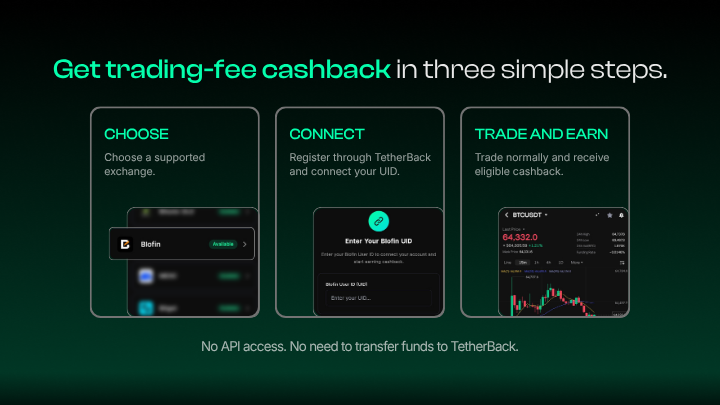
Grid bots are high-frequency tools. A well-configured spot grid on BTC/USDT can execute dozens of buy-sell cycles per day, each generating maker and taker fees. Over the course of a month, those fees accumulate meaningfully even at BingX's relatively low rate of 0.05% taker.
TetherBack's 50% cashback on BingX applies to all fee-generating activity on your linked account, including every order executed by your grid bots. This effectively halves your net grid trading cost without requiring any change to your strategy configuration. For active grid traders running multiple bots simultaneously, the cumulative cashback can represent a significant monthly USDT return.
Frequently Asked Questions
What is BingX grid trading?
BingX grid trading is an automated strategy tool that places buy and sell orders at preset price intervals within a defined range. The bot buys when the price drops to a grid level and sells when it rises to the next level, capturing the spread repeatedly as the price oscillates.
Does BingX grid trading require KYC?
Grid trading on BingX is accessible with the same KYC requirements as the rest of the platform. Basic grid bot functionality is available without full KYC. Completing verification unlocks higher allocation limits.
What is the difference between spot grid and futures grid on BingX?
Spot grid operates without leverage, buying and selling the underlying asset within a defined price range. Futures grid applies the same grid logic to perpetual futures contracts with leverage available, which amplifies both potential profit and liquidation risk.
What is the BingX infinity grid?
The infinity grid is a variant of spot grid trading that removes the upper price cap. Rather than selling out of a position when the price exceeds an upper bound, the infinity grid continues to rebalance upward, making it suitable for assets expected to trend higher over time without a defined price ceiling.
How many users are actively using BingX grid bots?
As of the most recent publicly available data, BingX's spot grid had over 160,000 active users with approximately $39.8 million invested, while the futures grid had over 27,000 users with approximately $41.6 million invested.
Can I use pre-configured grid templates on BingX?
Yes. BingX provides over 100 pre-configured grid templates based on historical volatility and price range analysis for various assets. These templates can be used as a starting point, though users should review the parameters before activating.
Does TetherBack cashback apply to fees generated by grid bots on BingX?
Yes. Grid bots generate trading fees on every buy and sell order executed within the grid. Since TetherBack's 50% cashback applies to fee-generating activity on your linked BingX account, all grid bot trading fees count toward your daily rebate calculation.
Glossary
-
Grid Trading: An automated trading strategy that places buy orders at intervals below the current price and sell orders above it, capturing profit from price oscillation within a defined range.
-
Grid Line: A price level within the grid range at which the bot places a buy or sell limit order.
-
Spot Grid: A grid trading configuration using spot market orders without leverage, buying and selling the actual asset within a price range.
-
Futures Grid: A grid trading configuration using perpetual futures contracts, with leverage available, adding both amplified profit potential and liquidation risk.
-
Infinity Grid: A variant of spot grid trading with no upper price bound, designed to follow long-term upward price trends by continuously rebalancing.
-
Price Range: The upper and lower price boundaries within which the grid bot places its automated buy and sell orders.
-
Grid Spread: The price difference between adjacent grid lines. A narrower spread produces more frequent but smaller trades. A wider spread produces less frequent but larger trades.
-
Unrealized PnL: The current profit or loss on open positions within the grid that have not yet been closed by a corresponding sell order.
-
Realized PnL: The profit or loss confirmed on closed grid cycles where a buy and sell order pair has both been executed.
-
Liquidation (Futures Grid): The forced closure of leveraged futures grid positions when margin falls below the maintenance threshold, a risk specific to futures grid configurations.
About TetherBack
TetherBack is a crypto cashback and rewards platform built for active traders who want to reduce effective trading costs. By partnering with supported exchanges, TetherBack shares a portion of trading fee revenue back to users in the form of cashback.
The platform does not hold user funds and does not operate as an exchange. Traders continue to execute trades directly on their chosen exchange while earning rewards through the partnership structure.
TetherBack focuses on cost efficiency, transparency, and providing traders with a structured way to maximize value from their existing trading activity.