
Is Crypto Cashback Worth It? A Real Cost–Benefit Analysis for Traders
Crypto cashback sounds attractive. The idea of getting part of your trading fees back is simple and appealing. But experienced traders usually ask a more important question:
Is it actually worth it?
The answer depends on how you trade, how often you trade, and how much you pay in fees.
Let us break it down logically.
Understanding the Real Cost of Trading Fees
Every trade comes with a fee. Whether you trade spot or futures, maker or taker, the exchange charges a percentage of your transaction value.
Individually, these fees may look small. But over time, they accumulate.
For example, if you trade $100,000 in total volume in a month at a 0.1% fee rate, you pay $100 in trading fees. If your volume increases to $500,000, the fee becomes $500.
This is where cashback enters the discussion. If a portion of those fees is returned, your effective trading cost drops.
The key question is how meaningful that drop becomes.
When Crypto Cashback Makes a Real Difference
Cashback becomes more valuable as trading volume increases.
Active traders who open and close positions frequently tend to generate higher total fees. Futures traders, scalpers, grid traders, and algorithmic traders often fall into this category.
If you trade occasionally, cashback may be modest. If you trade consistently, it becomes more noticeable.
The logic is simple. Higher volume leads to higher fees. Higher fees mean a larger base from which cashback is calculated.
Over months or years, even moderate fee reductions can improve net results.
Comparing Cashback to VIP Fee Discounts
Many exchanges offer VIP tiers. As your volume increases, your fee rate decreases.
So which is better: VIP discounts or cashback?
They work differently.
VIP tiers reduce the fee rate upfront. Cashback returns part of the fee after it is paid.
Some traders qualify for both. For example, they may benefit from a lower base fee rate and still receive cashback through a partnership structure such as TetherBack.
Cashback does not replace VIP discounts. It can complement them.
What Cashback Cannot Do
It is important to stay realistic.
Cashback will not turn an unprofitable strategy into a profitable one. It will not eliminate risk. It will not protect you from poor execution or emotional trading.
What it does is reduce friction.
If your strategy already has a positive edge, reducing fees strengthens that edge. If your strategy is inconsistent, fee reduction alone will not solve the problem.
Cashback should be seen as cost optimization, not profit generation.
Is It Worth the Effort?
Another practical question traders ask is whether signing up and using a cashback platform is worth the effort.
The answer depends on how simple the setup is and whether it changes your workflow.
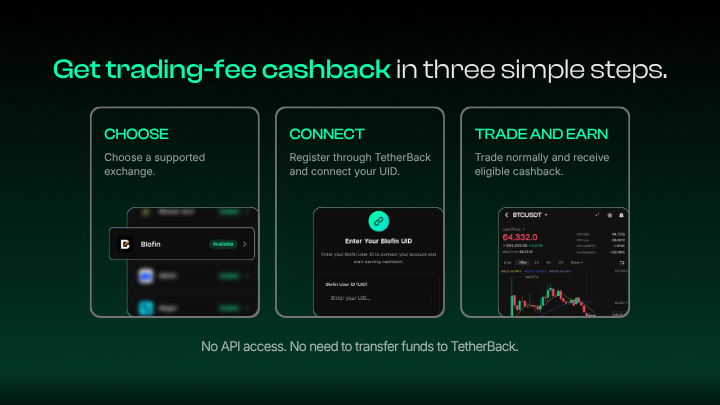
With platforms like TetherBack, traders continue trading directly on supported exchanges. The cashback structure works alongside normal trading activity.
If the process does not disrupt your strategy and you are already generating volume, then earning back a portion of fees can be a logical improvement.
If you trade rarely and pay minimal fees, the impact may be limited. In that case, the benefit is smaller.
Long-Term Perspective
The real value of cashback is not seen in a single week. It is seen over time.
Trading is often about small improvements compounded consistently. Lower slippage, better entries, stronger risk control, and reduced fees all contribute to overall performance.
Cashback fits into that framework as one of the smaller but steady optimizations.
It is not dramatic. It is practical.
Final Verdict
So, is crypto cashback worth it?
For active traders who generate consistent trading volume, yes, it can meaningfully reduce effective costs over time.
For low-frequency traders, the benefit exists but may be modest.
Cashback does not replace strategy, discipline, or risk management. It supports them by improving cost efficiency.
If you are already trading, reducing fees through structured cashback programs such as TetherBack is a rational step toward better long-term efficiency.
FAQ
Does crypto cashback guarantee profit?
No. Cashback reduces trading costs, but profitability depends on your trading decisions and market conditions.
Is cashback better than VIP fee tiers?
They serve different purposes. VIP tiers reduce fees upfront, while cashback returns part of the fee after trading. Some traders use both.
Who benefits the most from cashback?
Traders with consistent and higher trading volume typically benefit more because they generate more fees.
Is it complicated to use a cashback platform?
It depends on the platform, but structured systems like TetherBack are designed to work alongside your normal exchange trading without changing your strategy.
About TetherBack
TetherBack is a crypto cashback and rewards platform built for active traders who want to reduce effective trading costs. By partnering with supported exchanges, TetherBack shares a portion of trading fee revenue back to users in the form of cashback.
The platform does not hold user funds and does not operate as an exchange. Traders continue to execute trades directly on their chosen exchange while earning rewards through the partnership structure.
TetherBack focuses on cost efficiency, transparency, and providing traders with a structured way to maximize value from their existing trading activity.