
Lowest Crypto Futures Trading Fees in 2026: Which Exchange Actually Costs Less After Cashback?
At TetherBack, we compare the fee you actually pay after an eligible rebate, not just the commission displayed on an exchange advertising banner. That means looking separately at maker and taker orders, executed notional volume, spreads and the conditions of each cashback program.
Overview
Compare the final cost of trading, not just the percentage shown in an exchange advertisement. Maker and taker commissions, spreads, funding and eligible cashback affect the total.
Why this topic matters
On TetherBack’s exchange page, the displayed effective taker rates are 0.024% for Bitunix, 0.028% for WEEX, 0.030% for Bitget and 0.010% for MEXC. These are published examples, not a guarantee for every order.
We recommend checking the applicable account fee tier and matching each fill with its executed order type. A lower commission cannot compensate for an unfavorable entry, poor liquidity or excessive leverage.
Worked trading-cost example
At $100,000 of eligible taker turnover, the displayed effective costs would be $24 on Bitunix, $28 on WEEX, $30 on Bitget and $10 on MEXC. The volume includes the value of every fee-bearing execution.
The example below is educational and isolates transaction commissions. Unless stated otherwise, it excludes spreads, funding payments, borrowing charges, liquidation costs and market losses. The applicable exchange may calculate and settle cashback separately from the order.

How trading fee cashback fits in
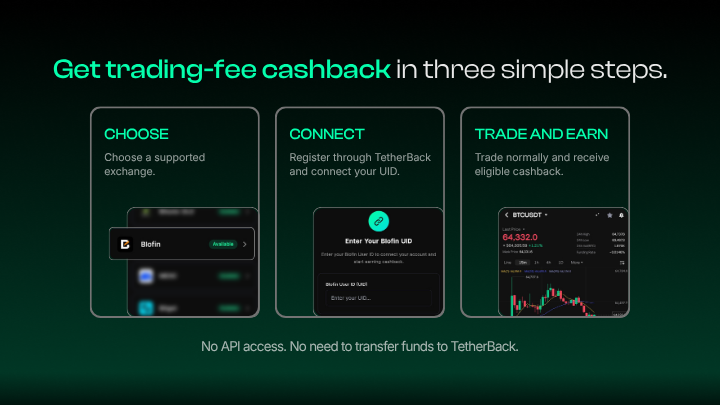
At TetherBack, we help qualifying traders recover part of eligible exchange commissions through supported partner arrangements. Users continue executing trades and holding trading funds with their exchanges; we do not need trading capital transferred to our platform.
Before assuming any advertised rebate applies, verify the registration source, supported product, current fee tier, payout terms and qualifying order types. Cashback cannot turn a losing trade into a risk-free transaction and should not encourage unnecessary volume.
How to check your eligibility and costs
- Check the current fee schedule inside your exchange account.
- Estimate maker and taker notional turnover for a representative month.
- Confirm cashback eligibility before using any referral offer.
- Register through an eligible partner link where required and follow UID-linking instructions.
- Track gross commissions, received cashback, funding and slippage separately.
- Keep an export of your trading history, calculate the commission paid on each fill and compare it with cashback actually credited. Reviewing these records monthly gives a more reliable view of net trading costs than relying on promotional figures alone.
Important limitations
MEXC charges can vary by region, market and promotion. Execution quality and the risk of loss also matter, so a lower commission does not necessarily mean a better trade.
Why the cheapest advertised fee can be misleading
If an exchange quotes a 0.02% maker fee, that figure describes one type of execution, not the total cost of every position. A limit order that crosses the spread can execute as a taker order. A stop-loss often needs an immediate fill, which also changes the fee calculation. We would rather compare the actual order history than build a recommendation around a single headline percentage. Take 100 completed trades and separate their entry and exit fills into maker and taker volume. Multiply each category by the applicable rate. Only then subtract cashback that the account actually qualified to receive. That gives you a number you can reconcile with exchange statements. It also exposes something a simple exchange ranking does not: a trader who uses more resting limit orders may reach a different conclusion from someone who relies on immediate market execution.
A practical comparison with mixed execution
Imagine $600,000 of total monthly futures turnover, with one-third charged as maker and two-thirds as taker. Using the illustrative reference schedule for Bitunix, $200,000 at 0.02% produces $40 and $400,000 at 0.06% produces $240. Gross commissions are $280. If the full amount qualifies for 60% cashback, the effective commission is $112. Use the same maker/taker split when comparing another exchange. Changing the assumptions halfway through makes the cheaper platform appear to win unfairly. The figures are only an example because fee tiers, promotions and eligible products vary. Funding payments belong in a separate column. So do execution spread and slippage. We consider a comparison useful when a trader can repeat the arithmetic with their own fills, not merely when it produces an attractive percentage on a landing page.
What our cost review cannot tell you
Commission arithmetic does not measure exchange reliability, asset custody, the quality of liquidation controls or whether a market has sufficient depth for a large order. Suppose one platform saves you $25 in monthly commissions, but market orders regularly fill at prices that are 0.05% worse on a $100,000 transaction. That execution difference alone is $50 and outweighs the fee saving. We would investigate that before suggesting a switch. A trader whose priority is immediate execution in volatile conditions may reasonably accept a somewhat higher fee for a better order book. A trader placing smaller passive orders may care more about maker pricing. There is no contradiction between those choices. They are different strategies with different total costs, and the objective is to find the better fit rather than a universal winner.
How we would audit a full month of futures fees
Start with the account's trade history, not its deposit history. Export fill-level records if the exchange offers them. Mark the executed notional value, timestamp, contract, commission, commission asset and maker/taker classification for each fill. Then group the fees by contract and execution type. Compare the result with the account's published tier and any fee discounts already applied. Add a separate column for cashback actually credited through the relevant partner arrangement. If the figures do not reconcile, check product eligibility and registration attribution before assuming the payout is missing. We recommend doing this monthly because changing VIP tiers and promotions make last month's rate an unreliable guide to next month's expenses. This review is more useful than estimating commissions from account equity or the leverage multiplier alone.
Glossary
- Maker fee: Commission on an executed order that adds order-book liquidity.
- Taker fee: Commission on an executed order that removes existing liquidity.
- Notional volume: Monetary value of executed positions, not just deposited margin.
- Cashback: Return of part of an eligible commission under a referral arrangement.
- Funding rate: Periodic payment between long and short perpetual futures traders.
- Slippage: Difference between expected and realized trade execution prices.
Frequently Asked Questions
Which futures exchange has the lowest effective taker fees?
Based solely on the currently displayed TetherBack comparison, MEXC shows the lowest example. Your actual account rate, execution and eligibility determine the result.
Is cashback trading profit?
No. Cashback is a partial refund of qualifying commission expenses. It does not guarantee a profitable trading result.
Are fees or cashback rates permanent?
No. Exchange schedules, account tiers and partnership offers may change. Always verify the latest terms before publication or trading.
How can I activate an eligible rebate?
Create a TetherBack account, use the official link for the selected exchange where required, then follow the UID and dashboard instructions.
Does the exchange with the biggest rebate always cost less?
No. Compare the original maker and taker rate as well as the rebate. A smaller refund on a lower commission may yield the better effective rate.
How should I measure trading fees over a month?
Export fill-level volume and commissions, separate maker from taker, and compare eligible cashback actually received with the estimate.
Conclusion
We recommend using the worked examples as a method rather than a promise. Verify current account fees, use your own trading history and reconcile actual cashback once credited. A lower eligible commission is useful, but it cannot remove trading risk.
About TetherBack
At TetherBack, we help eligible cryptocurrency traders recover part of qualifying trading fees through supported exchange partnerships. We publish practical fee comparisons and provide tools for estimating potential cashback. Traders keep control of their orders and funds on their selected exchanges. Eligibility, payout timing and product coverage depend on the relevant partner terms.