
Bitunix vs WEEX Futures Fees in 2026: Which Exchange Is Cheaper After Cashback?
We think the useful question is not which platform advertises the bigger rebate. It is whether Bitunix or WEEX leaves a lower net bill for the maker and taker mix you actually execute.
Overview
Bitunix and WEEX illustrate why a larger cashback percentage does not always produce the cheapest effective execution. Compare maker and taker rates separately.
Why this topic matters
The TetherBack listings currently show Bitunix at 0.008% effective maker and 0.024% effective taker, versus WEEX at 0.007% effective maker and 0.028% effective taker.
We recommend checking the applicable account fee tier and matching each fill with its executed order type. A lower commission cannot compensate for an unfavorable entry, poor liquidity or excessive leverage.
Worked trading-cost example
At $100,000 of qualifying taker turnover the illustration is $24 on Bitunix versus $28 on WEEX. For the same maker turnover, it is $8 versus $7.
The example below is educational and isolates transaction commissions. Unless stated otherwise, it excludes spreads, funding payments, borrowing charges, liquidation costs and market losses. The applicable exchange may calculate and settle cashback separately from the order.

How trading fee cashback fits in
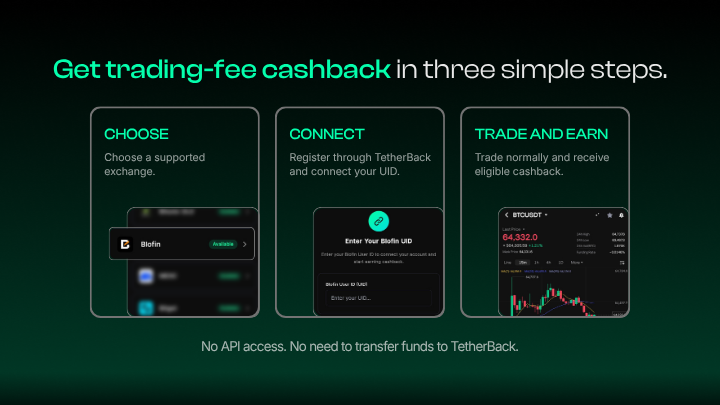
At TetherBack, we help qualifying traders recover part of eligible exchange commissions through supported partner arrangements. Users continue executing trades and holding trading funds with their exchanges; we do not need trading capital transferred to our platform.
Before assuming any advertised rebate applies, verify the registration source, supported product, current fee tier, payout terms and qualifying order types. Cashback cannot turn a losing trade into a risk-free transaction and should not encourage unnecessary volume.
How to check your eligibility and costs
- Check the current fee schedule inside your exchange account.
- Estimate maker and taker notional turnover for a representative month.
- Confirm cashback eligibility before using any referral offer.
- Register through an eligible partner link where required and follow UID-linking instructions.
- Track gross commissions, received cashback, funding and slippage separately.
- Keep an export of your trading history, calculate the commission paid on each fill and compare it with cashback actually credited. Reviewing these records monthly gives a more reliable view of net trading costs than relying on promotional figures alone.
Important limitations
For a limit-order strategy, maker rates may matter more; for market orders, taker rates matter more. Check liquidity, order fills and your own account settings.
The difference appears when your order mix changes
For standard reference futures fees, Bitunix and WEEX both list a 0.02% maker fee, while their taker rates differ. The advertised cashback percentages are also different. That means a comparison built around 100% market orders is not interchangeable with one built around 100% maker execution. Under the illustrative effective rates used in this article, Bitunix has a lower effective taker commission at 0.024% versus WEEX at 0.028%. For maker executions, WEEX has a slightly lower effective figure at 0.007% versus Bitunix at 0.008%. Neither result is a statement about fills, stability or the profitability of a strategy. It is a limited comparison of commissions, conditional on the published reference schedule and successful qualification for the full listed cashback arrangement.
Running the numbers on a mixed month
Suppose your trading history shows $400,000 of maker executions and $600,000 of taker executions in one month. On Bitunix's reference rates, that generates $80 in maker commissions and $360 in taker commissions, or $440 before a potential rebate. If all $440 qualifies for 60% cashback, the effective commission is $176. Using WEEX's 0.02% maker and 0.08% taker reference rates, the same volume generates $80 plus $480, or $560. At 65% qualifying cashback, the effective commission is $196. Here Bitunix is $20 lower. Change the maker/taker ratio enough and the result can narrow or reverse. We prefer this worked comparison because traders can insert the mix they actually use rather than accepting an arbitrary ranking.
Where an apparent fee saving can disappear
Suppose you trade a less-liquid perpetual pair during a sharp move. A market order may cross several price levels before filling. Even a lower stated taker fee cannot guarantee a cheaper execution in that circumstance. Contract availability, order-book depth, spreads, latency and order-management features should be tested for the symbols you trade. We would also look at stop-order handling and whether reduce-only and post-only features are available in a form that suits the strategy. Paying a slightly higher commission may be acceptable if the exchange consistently meets another essential requirement. Conversely, a trader placing modest BTC or ETH limit orders might prioritize fees because spread and liquidity are less problematic in that use case. These considerations are why we describe a cost comparison, not an overall exchange endorsement.
What to verify before registering through a cashback partner
Open the applicable fee schedule for your account tier, then check whether your intended contract has any special promotion. Some platforms adjust fees for selected pairs, and higher VIP levels may have different rates. Next establish whether maker and taker commissions from your chosen product qualify for the partner rebate. Confirm whether cashback is credited automatically, claimed through a dashboard or settled according to another schedule. Finally review regional eligibility and referral attribution. We recommend completing those checks before a deposit or first high-volume session. The official exchange transaction record remains the source for gross fees, while the rebate statement should show what was actually credited. Keeping both allows you to calculate the true effective cost rather than relying on the estimates in this article.

Glossary
- Maker fee: Commission on an executed order that adds order-book liquidity.
- Taker fee: Commission on an executed order that removes existing liquidity.
- Notional volume: Monetary value of executed positions, not just deposited margin.
- Cashback: Return of part of an eligible commission under a referral arrangement.
- Funding rate: Periodic payment between long and short perpetual futures traders.
- Slippage: Difference between expected and realized trade execution prices.
Frequently Asked Questions
Is Bitunix cheaper than WEEX for all futures strategies?
No. Under the displayed figures Bitunix is cheaper for taker execution, but WEEX is cheaper for maker execution. Trading behavior can reverse the ranking.
Is cashback trading profit?
No. Cashback is a partial refund of qualifying commission expenses. It does not guarantee a profitable trading result.
Are fees or cashback rates permanent?
No. Exchange schedules, account tiers and partnership offers may change. Always verify the latest terms before publication or trading.
How can I activate an eligible rebate?
Create a TetherBack account, use the official link for the selected exchange where required, then follow the UID and dashboard instructions.
Is WEEX always more expensive than Bitunix?
No. Under the reference assumptions Bitunix has a lower effective taker fee, whereas WEEX has a slightly lower effective maker fee.
Should I choose solely on a $20 monthly commission difference?
No. Check liquidity, order types, contract availability, regional access and slippage before changing platforms.
Conclusion
We recommend using the worked examples as a method rather than a promise. Verify current account fees, use your own trading history and reconcile actual cashback once credited. A lower eligible commission is useful, but it cannot remove trading risk.
About TetherBack
At TetherBack, we help eligible cryptocurrency traders recover part of qualifying trading fees through supported exchange partnerships. We publish practical fee comparisons and provide tools for estimating potential cashback. Traders keep control of their orders and funds on their selected exchanges. Eligibility, payout timing and product coverage depend on the relevant partner terms.