
Bitunix Fees Explained: How Much Do You Really Pay When Trading?
Trading fees are one of the most important costs to understand before actively trading cryptocurrency. While they may seem small on individual trades, they accumulate quickly over hundreds or even thousands of orders.
Whether you're trading Bitcoin, Ethereum, Solana, or other cryptocurrencies on Bitunix, understanding how trading fees work can help you better manage your overall trading costs.
At TetherBack, we help traders reduce their effective trading costs by returning 60% of Bitunix trading fees through our cashback partnership.
In this guide, we'll explain Bitunix maker and taker fees, how trading fees are calculated, and how cashback helps lower your effective trading costs.

What Are Bitunix Trading Fees?
Trading fees are the charges paid whenever a trade is executed on Bitunix.
These fees apply across various trading products, including:
-
Spot trading
-
Futures trading
-
Copy trading
-
API trading
Every executed order generates a trading fee based on:
-
Order size
-
Fee rate
-
Order type (maker or taker)
The larger your trading volume, the larger your total trading fees become.
Bitunix Trading Fees
Bitunix currently displays the following trading fees:
| Fee Type | Trading Fee |
|---|---|
| Maker Fee | 0.008% |
| Taker Fee | 0.024% |
These are the standard trading fees before any cashback is applied.
Understanding the difference between maker and taker orders is important because each carries a different fee.
What Is a Maker Fee?
A maker fee applies when your order adds liquidity to the order book.
Common examples include:
-
Limit orders
-
Orders waiting to be filled
-
Passive entries
Maker orders help build liquidity in the market, which is why they typically have lower fees.
Examples of Maker Orders
-
Placing a limit buy below the current market price
-
Placing a limit sell above the current market price
-
Waiting for another trader to fill your order
What Is a Taker Fee?
A taker fee applies when your order immediately matches an existing order.
Examples include:
-
Market orders
-
Immediate limit order executions
-
Orders that instantly remove liquidity
Since taker orders consume liquidity, they generally have higher fees than maker orders.
Bitunix Trading Fee Examples
Maker Orders
| Trading Volume | Maker Fee | Trading Fee |
|---|---|---|
| $50,000 | 0.008% | $4 |
| $100,000 | 0.008% | $8 |
| $500,000 | 0.008% | $40 |
| $1,000,000 | 0.008% | $80 |
Taker Orders
| Trading Volume | Taker Fee | Trading Fee |
|---|---|---|
| $50,000 | 0.024% | $12 |
| $100,000 | 0.024% | $24 |
| $500,000 | 0.024% | $120 |
| $1,000,000 | 0.024% | $240 |
Although these costs appear relatively small, they become much more significant as trading volume increases.
How Trading Fees Are Calculated
The basic calculation is straightforward:
Trading Fee = Trade Size × Trading Fee Rate
For example:
Example 1
Trade Size:
$100,000
Maker Fee:
0.008%
Trading Fee:
$8
Example 2
Trade Size:
$100,000
Taker Fee:
0.024%
Trading Fee:
$24
The fee is charged when your order is executed.
For futures traders, fees are generally paid when opening and closing positions.
Why Trading Fees Matter
Trading fees affect every trader regardless of whether the trade is profitable.
You pay fees when you:
-
Open positions
-
Close positions
-
Buy crypto
-
Sell crypto
-
Trade futures
-
Trade spot
-
Use copy trading
-
Trade through APIs
For traders executing hundreds of trades each month, fees can become one of the largest ongoing expenses.
Reducing those costs helps improve long-term profitability.

Reduce Bitunix Fees With TetherBack
At TetherBack, we return 60% of Bitunix trading fees through our cashback partnership.
Cashback is distributed in two parts:
| Cashback Distribution | Percentage |
|---|---|
| Automatically credited to your Bitunix Spot Wallet | 30% |
| Claimable through your TetherBack dashboard | 30% |
| Total Cashback | 60% |
For every $100 paid in trading fees:
-
$30 is automatically credited to your Bitunix Spot Wallet.
-
$30 is claimable through your TetherBack dashboard.
-
Total cashback equals $60.
-
Your effective trading cost becomes $40.
You continue trading normally while cashback is automatically earned.
Effective Trading Costs After Cashback
The Bitunix trading fees remain exactly the same.
However, after cashback is received, your effective trading costs become:
| Fee Type | Bitunix Fee | Cashback | Effective Cost |
|---|---|---|---|
| Maker | 0.008% | 60% | 0.0032% |
| Taker | 0.024% | 60% | 0.0096% |
This illustrates how cashback lowers your overall trading expenses without changing the exchange's published fee schedule.
Monthly Trading Fee Calculator
The following example assumes:
-
22 trading days each month
-
0.024% taker fee
-
60% cashback
| Daily Trading Volume | Monthly Volume | Trading Fees | Cashback | Effective Cost |
|---|---|---|---|---|
| $50,000 | $1,100,000 | $264 | $158.40 | $105.60 |
| $100,000 | $2,200,000 | $528 | $316.80 | $211.20 |
| $200,000 | $4,400,000 | $1,056 | $633.60 | $422.40 |
| $500,000 | $11,000,000 | $2,640 | $1,584 | $1,056 |
For high-volume traders, cashback can significantly reduce annual trading costs.
Other Ways to Reduce Bitunix Trading Fees
Besides cashback, traders can also reduce costs by:
-
Using maker orders whenever possible
-
Avoiding unnecessary trades
-
Planning entries with limit orders
-
Monitoring monthly trading costs
-
Avoiding emotional trading
-
Reviewing trade performance regularly
-
Managing trading frequency
-
Understanding the difference between maker and taker orders
Small improvements in execution can lead to meaningful savings over time.
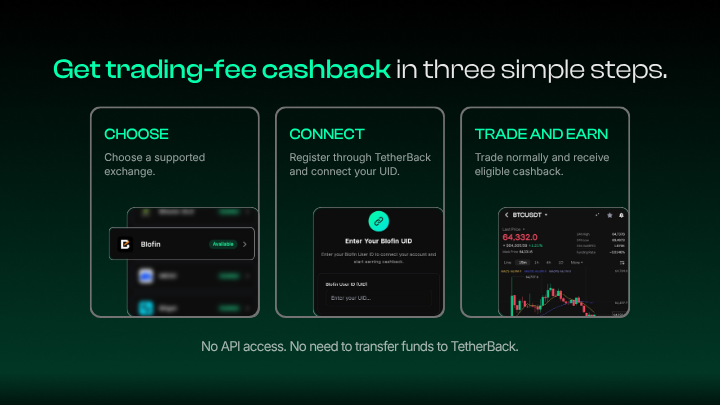
How to Set Up Bitunix Cashback Through TetherBack
Getting started only takes a few minutes.
Step 1: Create a TetherBack Account
Step 2: Open the Exchanges Page
Inside your dashboard:
-
Go to Exchanges
-
Select Bitunix
Step 3: Register Through the Bitunix Partner Link
Click the Bitunix registration link provided by TetherBack.
This ensures your Bitunix account is connected to the cashback program.
Step 4: Complete Your Bitunix Registration
Create your Bitunix account and enable:
-
Strong password
-
Two-factor authentication
-
Email verification
-
Additional security settings
Step 5: Find Your Bitunix UID
Inside Bitunix:
-
Open your Profile
-
Locate your UID
-
Copy your UID
Step 6: Connect Your UID
Return to TetherBack and paste your Bitunix UID into the Connected Exchange section.
Step 7: Start Trading
Trade normally on Bitunix.
Once connected, cashback begins accumulating automatically.
Important: Bitunix cashback through TetherBack requires your Bitunix account to be registered using the TetherBack partner link.
Frequently Asked Questions
What are Bitunix trading fees?
Bitunix currently displays:
-
Maker Fee: 0.008%
-
Taker Fee: 0.024%
What's the difference between maker and taker fees?
Maker fees apply when your order adds liquidity to the order book.
Taker fees apply when your order immediately executes against existing liquidity. (Bitunix)
How much cashback does TetherBack offer?
Bitunix traders receive 60% trading fee cashback through TetherBack.
Do I need API keys?
No.
We only require your Bitunix UID.
No API keys, trading permissions, or withdrawal permissions are needed.
Does cashback change Bitunix's trading fees?
No.
The published Bitunix fee schedule stays the same.
Cashback simply reduces your effective trading cost after rebates are returned.
Does cashback apply to copy trading?
Yes.
Cashback applies to qualifying trading activity on your connected Bitunix account.
Glossary
Maker Fee
The fee charged when an order adds liquidity to the order book.
Taker Fee
The fee charged when an order immediately removes liquidity from the order book.
Trading Fee
The fee charged whenever a trade is executed.
Cashback
A rebate that returns a percentage of paid trading fees.
UID
Your unique Bitunix account identifier used to connect your Bitunix account with TetherBack.
Spot Trading
Buying and selling cryptocurrencies directly without leverage.
Futures Trading
Trading perpetual contracts based on cryptocurrency price movements. (Bitunix)
Effective Trading Cost
The amount you effectively pay after cashback has been returned.
About TetherBack
TetherBack is a crypto cashback platform built for active traders who want to reduce their trading costs.
We do not operate as an exchange or hold user funds. Instead, we partner with supported exchanges and return a portion of trading fees back to users as cashback.
For Bitunix traders, we currently provide 60% trading fee cashback, helping reduce the effective cost of spot trading, futures trading, copy trading, and API trading.