
Crypto Futures Order Types Explained: Market, Limit, Stop, and More
Beginner’s Guide to Crypto Futures Order Types
If you are new to crypto futures, one of the first things you need to learn is how order types work. Many beginners focus only on whether they want to buy or sell, but the order type determines how that trade is executed. In practice, the difference between a market order, limit order, or stop order can affect your entry price, your exit plan, and your risk management.
For beginners, the good news is that most crypto futures order types can be understood with a few basic ideas. A market order is about speed. A limit order is about price control. A stop order is about triggering an action once the market reaches a certain level. Once those basics are clear, the more advanced order types become much easier to understand.
This matters even more in futures trading than in casual spot trading because futures positions often involve leverage, margin, and liquidation risk. The order type you choose can shape not just how a trade opens, but how it closes and how well your risk is managed. That is why learning crypto futures order types is one of the most practical parts of any beginner crypto trading guide.

What Are Crypto Futures Order Types?
Crypto futures order types are instructions you give the platform about how you want a futures contract to be bought or sold. Instead of simply clicking buy or sell and leaving everything to chance, order types let you define whether execution should happen immediately, only at a certain price, or only after the market reaches a trigger level.
In simple terms, order types help answer three beginner questions:
- Do I want the trade to happen now?
- Do I want the trade only at a specific price?
- Do I want the trade to activate only if the market reaches a trigger price?
Those questions cover most of the basics behind how to place futures orders.
Market Order: Fastest Execution, Least Price Control
A market order tells the platform to execute your trade immediately at the best available current price.
For beginners, this is the easiest order type to understand. You are prioritizing speed over precision. If you want to enter or exit a position right away, a market order is the most direct option.
Example
Imagine BTC futures are trading around $100,000. You decide you want to open a long position immediately. A market order tells the platform to fill that order as quickly as possible at the best available price in the order book. If liquidity is deep, the fill may be very close to the displayed price. If liquidity is thinner or the order is large, the execution price may vary.
Pros
- Fast execution
- Simple for beginners
- Useful when immediate entry or exit matters most
Cons
- Less control over final execution price
- More exposure to slippage in fast-moving markets or thinner books
Limit Order: More Price Control, No Guarantee of Fill
A limit order lets you set the price at which you are willing to buy or sell.
For beginners, this means a limit order is about control. You are telling the platform to execute your trade only if the market can fill you at that price or better.
Example
Imagine ETH futures are trading at $3,000, but you only want to open a long position if the market dips to $2,950. You place a buy limit order at $2,950. If the market reaches that level and there is matching liquidity, your order may fill. If the market never touches that price, the order may remain unfilled.
Pros
- Better control over price
- Useful for planned entries and exits
- Helps avoid paying worse prices than intended
Cons
- No guarantee the order will fill
- The market may move away before execution

Market Order vs Limit Order
For anyone comparing market order vs limit order setups, the simplest difference is:
- Market order prioritizes execution speed
- Limit order prioritizes price control
If you care most about getting into or out of a position immediately, market orders are usually the better choice. If you care more about the exact price and are willing to wait, limit orders are often more appropriate.
Stop Order: Triggered by Price
A stop order becomes active only after the market reaches a specified stop price. It is a conditional order that waits for a trigger, then becomes an actual order.
Stop orders are commonly used for:
- Stopping losses
- Entering on a breakout
- Automating exits or entries
Stop-Market Order
A stop-market order becomes a market order once the stop price is reached.
Example
Suppose you are long BTC futures from $100,000 and want to limit downside risk if the market falls. You place a stop-market sell order with a stop price at $98,000. If BTC drops to that level, the order becomes a market sell order and exits at the best available price.
Benefit
- Higher chance of execution once triggered
Limitation
- Final execution price may be worse than expected
Stop-Limit Order
A stop-limit order activates when the stop price is reached, but instead of becoming a market order, it becomes a limit order.
Example
- Stop price: $2,950
- Limit price: $2,940
If the stop is hit, a limit sell order is placed at $2,940. This gives more control, but if the market falls too quickly, the order may not fill.
Benefit
- More control over execution price
Limitation
- No guarantee of execution
Take-Profit Orders
Take-profit orders are used to close a position once a profit target is reached.
Example
If you open a long BTC futures position at $100,000 and want to close it around $104,000, a take-profit order can automate that exit instead of requiring constant monitoring.
Trailing Stop
A trailing stop adjusts as the market moves in your favor, helping protect gains while allowing the trade to continue.
For beginners, it can be thought of as a stop that follows the market at a fixed distance or percentage rather than staying at a fixed price.
Other Advanced Order Types
Some platforms offer additional order types such as post-only, TWAP, scaled orders, reverse orders, conditional orders, and iceberg orders. These are useful tools but are not essential for beginners.
Most beginners should focus on:
- Market
- Limit
- Stop-market
- Stop-limit
- Take-profit
- Trailing stop (after basics are understood)
How to Place Futures Orders as a Beginner
A practical beginner workflow:
- Decide whether you are entering or exiting
- Decide whether speed or price matters more
- Decide if a trigger-based order is needed
- Plan risk before entering the trade
Why Order Types Matter More in Futures
In futures trading, order types matter more because of:
- Slippage
- Leverage
- Liquidation risk
- Funding costs
A poor order choice can lead to worse entries, missed exits, or poor risk control.
How TetherBack Can Help Reduce Trading Fees
Once you understand order types, the next issue is cost. Active traders often place many orders, and fees can add up.
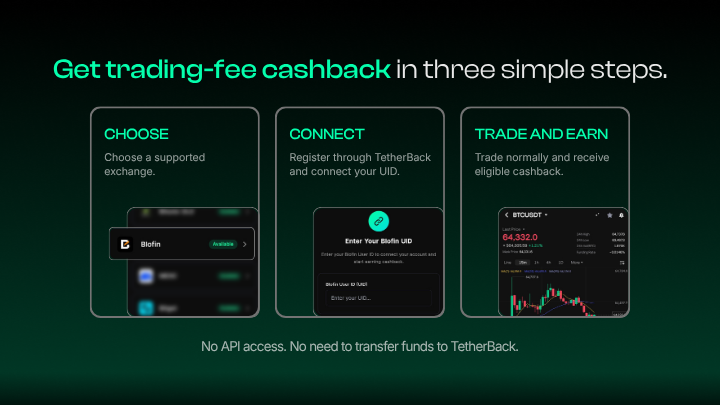
TetherBack is a platform designed to help reduce trading fee costs through cashback. Users sign up via TetherBack, connect a supported exchange account, and may receive cashback on eligible trading activity.
This does not remove market risk or change execution, but it can improve cost efficiency over time.
Glossary
- Market order: Executes immediately at the best available price
- Limit order: Executes only at a specified price or better
- Stop order: Activates when a trigger price is reached
- Stop-market order: Becomes a market order after triggering
- Stop-limit order: Becomes a limit order after triggering
- Take-profit order: Closes a position at a target profit level
- Trailing stop: Adjusts with the market to protect gains
- Slippage: Difference between expected and actual execution price
- Liquidity: Amount of buy/sell interest in the market
- Order book: List of pending buy and sell orders
- Perpetual futures: Futures contracts with no expiration
- UID: Account identifier used for linking to TetherBack
FAQ
What is the difference between a market order and a limit order?
A market order executes immediately at the best available price, while a limit order executes only at a specific price or better.
What is a stop order?
A conditional order that activates once a trigger price is reached.
What is a stop-market order?
A stop order that becomes a market order after triggering.
What is a stop-limit order?
A stop order that becomes a limit order after triggering.
What is a take-profit order?
An order used to close a position at a predefined profit level.
Which order type is best for beginners?
Market, limit, and basic stop orders are the most important to learn first.
Can TetherBack reduce trading costs?
It can reduce part of trading fees through cashback if set up correctly.
Conclusion
Crypto futures order types are easier to understand when broken into simple roles:
- Market orders focus on speed
- Limit orders focus on price control
- Stop orders focus on triggering actions
More advanced variations like stop-market, stop-limit, take-profit, and trailing stop simply refine execution and risk management.
Learning how to use these correctly helps improve control, reduce mistakes, and support better trading decisions. For active traders, managing costs also matters, and platforms like TetherBack can help improve fee efficiency.
About TetherBack
TetherBack is a crypto cashback and rewards platform designed for active traders who want to reduce effective trading costs. By partnering with supported exchanges, it shares a portion of trading fee revenue back to users as cashback.
The platform does not hold user funds and does not operate as an exchange. Traders execute trades on their chosen exchange while earning rewards through the partnership.
TetherBack focuses on cost efficiency, transparency, and helping traders maximize value from their existing activity.