
Trading fees may look small when you only consider one position.
For an active futures trader, they can become a much larger expense once trading volume starts reaching hundreds of thousands or millions of dollars.
Bitget's standard futures trading fees covered in this guide are:
| Order Type | Bitget Futures Fee |
| Maker | 0.02% |
| Taker | 0.06% |
A trader generating $1 million in taker volume at a 0.06% fee can generate:
$1,000,000 × 0.06% = $600 in trading fees
At $10 million in volume:
$10,000,000 × 0.06% = $6,000
That is why learning how to reduce Bitget trading fees becomes increasingly important as trading activity grows.
There are several ways traders can potentially reduce their effective costs, including using maker orders where appropriate, avoiding unnecessary transactions, monitoring funding, checking available account fee tiers and receiving trading fee cashback.
For eligible traders using TetherBack, the current Bitget offer provides:
50% trading fee cashback
Using Bitget's standard futures rates, that can reduce the effective cost from:
0.02% maker → 0.01% after cashback
and
0.06% taker → 0.03% after cashback
Here are seven practical ways to reduce the amount you effectively spend on Bitget trading fees.

Why Reducing Bitget Fees Matters
Trading fees directly reduce your net trading result.
Imagine your strategy generates:
$5,000 in gross trading profit
but you also generate:
$1,500 in trading fees
Before considering other costs, your result becomes:
$3,500
That means 30% of your gross trading profit has effectively been consumed by transaction fees.
For high-frequency traders, scalpers and futures traders, fees can have an even larger impact because positions are opened and closed frequently.
Reducing those costs does not improve your win rate.
It simply means less of your trading performance is being consumed by fees.
1. Understand Bitget Maker and Taker Fees
The first step to reducing Bitget fees is understanding what you are actually paying.
Bitget's standard futures rates covered here are:
Maker: 0.02%
Taker: 0.06%
The difference is significant.
A taker execution at the standard rate costs three times as much as a maker execution.
What Is a Maker Order?
A maker order adds liquidity to the order book.
This normally happens when you place a limit order that does not execute immediately.
For example:
BTC is trading at $100,000.
You place a limit buy order at $99,500.
The order remains on the order book waiting to be filled.
If it later executes as a maker order, the standard futures fee is:
0.02%
What Is a Taker Order?
A taker order removes liquidity already available on the order book.
This commonly happens when:
- You place a market order
- Your order executes immediately
- A limit order immediately matches an existing order
The standard Bitget futures taker fee is:
0.06%
Understanding this difference is one of the simplest ways to understand where your trading costs are coming from.
2. Use Maker Orders When They Fit Your Strategy
Because Bitget's standard futures maker fee is lower than the taker fee, maker execution can reduce transaction costs.
Consider $1 million in trading volume.
Maker
$1,000,000 × 0.02% = $200
Taker
$1,000,000 × 0.06% = $600
Difference:
$400
At $10 million:
| Execution Type | Trading Fee |
|---|---|
| Maker at 0.02% | $2,000 |
| Taker at 0.06% | $6,000 |
Difference:
$4,000
For a high-volume trader, that difference is substantial.
However, this does not mean you should always use limit orders purely to pay a lower fee.
A maker order may not fill.
The market could move away from your desired entry.
Your strategy may require immediate execution.
Therefore, consider:
- Execution speed
- Slippage
- Liquidity
- Market conditions
- Entry requirements
- Risk management
A lower fee is only valuable if the execution still fits the strategy.
3. Avoid Unnecessary Overtrading
One of the simplest ways to reduce Bitget trading fees is to stop generating fees on trades that do not need to exist.
Every new entry and exit can create another transaction cost.
Imagine a trader makes:
5 trades per day
and each complete trade involves both an entry and an exit.
That can mean:
10 fee-generating executions per day
If the trader increases that to:
15 trades per day
without improving the strategy, the number of fee-generating transactions triples.
More trading does not automatically mean more profit.
But it almost always means more transaction costs.
Before entering another position, ask:
- Does this meet my strategy?
- Is there a clear setup?
- Am I trading because of a signal or boredom?
- Am I trying to recover a previous loss?
- Is the expected move large enough to justify fees and other costs?
Reducing poor-quality trades can reduce both trading fees and unnecessary risk.
4. Calculate the Full Cost of Opening and Closing
A common mistake is looking at the fee for entering a trade and forgetting that closing the position can create another fee.
Consider a:
$100,000 futures position
opened using taker execution.
Opening fee:
$100,000 × 0.06% = $60
If it is closed at approximately the same notional value using another taker order:
Closing fee:
$100,000 × 0.06% = $60
Approximate total transaction cost:
$120
This is your round-trip trading cost.
For a $1 million position:
Opening:
$600
Closing:
$600
Total:
$1,200
This is why active traders should calculate fees across the complete trade rather than only the entry.
5. Monitor Futures Funding Costs
Trading fees are not the only expense futures traders need to consider.
Perpetual futures positions can also involve funding payments.
Funding and trading fees are different.
Trading Fees
Generated when an order executes.
Funding
A periodic payment associated with holding perpetual futures positions through applicable funding settlement periods.
Even if you successfully reduce your maker or taker transaction fees, holding a position through unfavorable funding periods can increase your overall trading cost.
Before holding a futures position for a longer period, check:
- Current funding rate
- Next funding time
- Position size
- Expected holding period
- Whether you are paying or receiving funding
A trading strategy should be evaluated based on total cost, not transaction fees alone.
6. Check Whether You Qualify for Lower Bitget Fee Tiers
The standard Bitget futures fees used throughout this guide are:
0.02% maker
0.06% taker
But not every trader necessarily pays the same rate.
Crypto exchanges can offer different fee levels depending on factors such as:
- Trading volume
- Account tier
- VIP status
- Promotional conditions
- Specific trading products
High-volume traders should check their actual Bitget fee level instead of automatically assuming the standard fee applies.
If your account qualifies for a lower trading fee tier, that can reduce costs before cashback is even considered.
Always calculate using the actual rate displayed for your account.
7. Get 50% Bitget Trading Fee Cashback Through TetherBack
One of the most direct ways eligible traders can reduce their effective Bitget trading fees is through cashback.
TetherBack currently offers eligible Bitget traders:
50% trading fee cashback
This means part of the applicable trading fees generated through your eligible account is returned to you.
Using Bitget's standard futures fees:
| Order Type | Standard Bitget Fee | 50% Cashback | Effective Cost |
|---|---|---|---|
| Maker | 0.02% | 50% | 0.01% |
| Taker | 0.06% | 50% | 0.03% |
The distinction is important.
Bitget still charges the applicable trading fee.
TetherBack cashback then reduces your effective cost after the cashback is received.
How Much Can 50% Bitget Cashback Save?
Consider $100,000 in futures taker volume.
Standard fee:
$100,000 × 0.06% = $60
50% cashback:
$60 × 50% = $30
Effective cost:
$30
Now increase the volume.
| Taker Volume | Standard Fee at 0.06% | 50% Cashback | Effective Cost |
|---|---|---|---|
| $10,000 | $6 | $3 | $3 |
| $50,000 | $30 | $15 | $15 |
| $100,000 | $60 | $30 | $30 |
| $500,000 | $300 | $150 | $150 |
| $1,000,000 | $600 | $300 | $300 |
| $5,000,000 | $3,000 | $1,500 | $1,500 |
| $10,000,000 | $6,000 | $3,000 | $3,000 |
The higher your existing fee-generating volume, the larger the dollar value of the cashback.
Bitget Maker Fee Savings With Cashback
The same calculation applies to maker orders.
Standard maker fee:
0.02%
With 50% cashback:
0.01% effective cost
| Maker Volume | Standard Fee | 50% Cashback | Effective Cost |
|---|---|---|---|
| $100,000 | $20 | $10 | $10 |
| $500,000 | $100 | $50 | $50 |
| $1,000,000 | $200 | $100 | $100 |
| $5,000,000 | $1,000 | $500 | $500 |
| $10,000,000 | $2,000 | $1,000 | $1,000 |
For an active maker trader generating $10 million in qualifying volume, 50% cashback represents:
$1,000 in recovered trading fees
under these assumptions.
How Much Could an Active Bitget Trader Save Per Month?
Consider someone generating:
$500,000 in taker trading volume per day
over:
22 trading days
Monthly volume:
$500,000 × 22 = $11,000,000
At a standard 0.06% taker fee:
$11,000,000 × 0.06% = $6,600
Trading fees:
$6,600
With 50% cashback:
$6,600 × 50% = $3,300
Effective trading cost:
$3,300
The trader therefore recovers:
$3,300
If the same hypothetical volume and fee structure continued for 12 months:
$3,300 × 12 = $39,600
That would represent $39,600 in annual cashback.
This is only an illustration. Actual cashback depends on real trading volume, eligibility, trading fees and current TetherBack terms.
Monthly Bitget Fee Savings Calculator
Using the standard 0.06% futures taker fee and 50% cashback:
| Daily Volume | 22-Day Volume | Standard Fees | Cashback | Effective Cost |
|---|---|---|---|---|
| $50,000 | $1.1M | $660 | $330 | $330 |
| $100,000 | $2.2M | $1,320 | $660 | $660 |
| $200,000 | $4.4M | $2,640 | $1,320 | $1,320 |
| $500,000 | $11M | $6,600 | $3,300 | $3,300 |
| $1,000,000 | $22M | $13,200 | $6,600 | $6,600 |
For high-volume traders, trading fee optimization can therefore have a major impact on net trading costs.
Combining Maker Orders With Cashback
Cashback does not have to be the only method used to reduce effective trading costs.
Consider $1 million in futures volume.
Standard Taker Execution
0.06% fee:
$600
Taker With 50% Cashback
Effective cost:
$300
Standard Maker Execution
0.02% fee:
$200
Maker With 50% Cashback
Effective cost:
$100
The lowest cost in this example is achieved when eligible maker trading receives the full cashback:
$100 effective trading cost
compared with:
$600 standard taker cost
That is an $500 difference per $1 million in trading volume.
Again, this does not mean every order should be forced into maker execution.
The order still needs to fit the strategy.

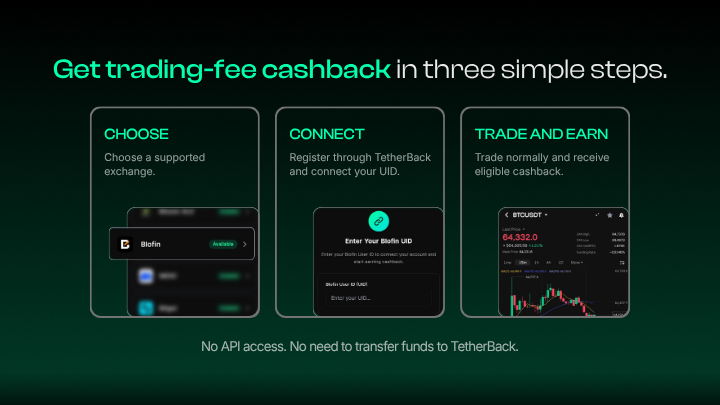
How to Activate Bitget Cashback Through TetherBack
The setup process is straightforward.
Step 1: Create Your TetherBack Account
Register through:
Create your TetherBack account
Step 2: Find Bitget
Open the supported exchanges section inside TetherBack and select Bitget.
Step 3: Activate the Bitget Offer
Follow the Bitget registration process provided by TetherBack.
This is important because your account needs to be connected to the applicable partnership for cashback eligibility.
Step 4: Create Your Eligible Bitget Account
Complete the required Bitget account setup.
Step 5: Find Your Bitget UID
Log in to Bitget and locate your unique UID.
Step 6: Connect Your UID to TetherBack
Return to your TetherBack dashboard and add your Bitget UID.
Check the UID carefully before completing the connection.
Step 7: Trade Normally
Continue executing trades directly through Bitget.
You do not need to:
- Transfer your trading capital to TetherBack
- Execute trades through TetherBack
- Change your trading strategy
- Move positions away from Bitget
Your trading activity remains on Bitget.
Step 8: Track Your Cashback
Use your TetherBack dashboard to monitor eligible cashback generated from your connected exchange activity.
Start earning Bitget trading fee cashback
Should You Trade More to Earn More Cashback?
No.
This is an important distinction.
Higher trading volume can generate more fees, which can generate more cashback.
But deliberately increasing trading volume purely to earn cashback makes little financial sense.
For example:
Generate an additional:
$600 in trading fees
Receive:
$300 cashback
You have still incurred:
$300 in effective cost
Cashback should therefore reduce the cost of trading you were already going to do.
It should not be the reason for creating unnecessary trades.
Does Lowering Fees Improve Trading Performance?
Reducing fees cannot turn a bad trading strategy into a profitable one.
But it can improve the net result of a strategy that already has an edge.
Consider a strategy generating:
$10,000 gross profit
With $4,000 in Trading Costs
Net result:
$6,000
With $2,000 in Effective Trading Costs
Net result:
$8,000
The strategy itself did not change.
The difference came from reducing costs.
This is why professional traders often monitor transaction costs closely.
What Type of Trader Benefits Most From Lower Bitget Fees?
Trading fee reduction becomes increasingly valuable as fee-generating activity increases.
Futures Traders
Repeated entries and exits can generate substantial notional trading volume.
Scalpers
Small-target strategies can be particularly sensitive to transaction costs.
Day Traders
Multiple trades per session mean fees can accumulate quickly.
High-Volume Traders
Millions of dollars in monthly volume can turn seemingly small percentages into thousands of dollars.
Algorithmic Traders
Automated strategies may generate large numbers of transactions.
API Traders
Systematic execution can create substantial cumulative volume.
Copy Traders
Repeated copied positions can also generate trading fees.
For all of these traders, reducing costs can make more of the strategy's gross performance remain after fees.
Common Mistakes That Increase Bitget Trading Costs
Using Market Orders for Every Trade
Market orders are convenient but normally execute as taker orders.
With standard Bitget futures fees:
Maker: 0.02%
Taker: 0.06%
Using taker execution unnecessarily can significantly increase costs.
Ignoring Exit Fees
Opening a position is only half of the trade.
Closing can generate another transaction fee.
Ignoring Funding
A low transaction fee can be offset by unfavorable funding if a perpetual futures position is held for long periods.
Overtrading
More trades create more fees.
Ignoring Account Fee Tiers
High-volume traders should check whether their account qualifies for a different fee level.
Focusing Only on Signup Bonuses
A small one-time bonus may be less valuable than recurring fee savings for an active trader.
Not Using Available Cashback
If an eligible trader generates substantial fees without a cashback arrangement, those potential rebates are not being recovered.
Bitget Fee Reduction Example: $10 Million in Volume
Suppose a trader generates:
$10 million in futures trading volume
Standard Taker Fee
0.06%:
$6,000
Taker With 50% Cashback
Effective cost:
$3,000
Standard Maker Fee
0.02%:
$2,000
Maker With 50% Cashback
Effective cost:
$1,000
The difference between standard taker execution and eligible maker execution with 50% cashback is:
$5,000
That is why execution type and cashback become increasingly important as trading volume grows.
How to Calculate Your Own Bitget Fees
The simplest formula is:
Trading Volume × Fee Rate = Trading Fee
For example:
$250,000 × 0.06% = $150
If eligible for 50% cashback:
$150 × 50% = $75 cashback
Effective cost:
$75
For maker:
$250,000 × 0.02% = $50
50% cashback:
$25
Effective cost:
$25
You can use the same calculation with your own monthly trading volume.
How Much Does Bitget Charge per $100,000?
Using the standard futures fees:
| Execution | Standard Cost | After 50% Cashback |
|---|---|---|
| Maker | $20 | $10 |
| Taker | $60 | $30 |
So for every $100,000 of qualifying futures trading volume:
Maker effective cost: approximately $10
Taker effective cost: approximately $30
after receiving the full applicable 50% cashback.
How Much Does Bitget Charge per $1 Million?
At $1 million:
| Execution | Standard Cost | After 50% Cashback |
|---|---|---|
| Maker | $200 | $100 |
| Taker | $600 | $300 |
This is where the impact of fee reduction becomes easier to see.
How Much Does Bitget Charge per $10 Million?
At $10 million:
| Execution | Standard Cost | After 50% Cashback |
|---|---|---|
| Maker | $2,000 | $1,000 |
| Taker | $6,000 | $3,000 |
For active traders, these costs can recur monthly.
That is why optimizing fees can potentially save thousands of dollars over time.
Frequently Asked Questions
How can I reduce Bitget trading fees?
Ways to potentially reduce Bitget trading costs include using maker orders where appropriate, avoiding unnecessary trades, calculating round-trip transaction costs, monitoring futures funding, checking your applicable account fee tier and using eligible trading fee cashback.
What are the standard Bitget futures fees?
The Bitget futures fees covered in this guide are:
0.02% maker
0.06% taker
Why is the Bitget maker fee lower?
Maker orders generally add liquidity to the order book, while taker orders remove existing liquidity.
Under the standard futures structure covered here, maker transactions therefore carry a lower fee.
How much is the Bitget taker fee?
The standard futures taker fee used in this guide is:
0.06%
How much is the Bitget maker fee?
The standard futures maker fee used in this guide is:
0.02%
Does TetherBack reduce Bitget fees?
TetherBack currently provides eligible Bitget traders with 50% trading fee cashback.
The exchange fee itself still applies, but receiving cashback reduces the effective cost.
What are Bitget fees after 50% cashback?
Using the standard futures rates:
0.02% maker → 0.01% effective cost
0.06% taker → 0.03% effective cost
Is 0.01% the normal Bitget maker fee?
No.
The standard maker fee covered in this guide is 0.02%.
The 0.01% figure represents the effective cost after receiving 50% cashback.
Is 0.03% the normal Bitget taker fee?
No.
The standard taker fee covered here is 0.06%.
The 0.03% figure represents the effective cost after receiving the full 50% cashback.
Does using limit orders reduce Bitget fees?
A limit order that executes as a maker can qualify for the lower maker fee.
However, not every limit order necessarily executes as a maker. If it immediately matches existing liquidity, it can execute as a taker.
Do I pay Bitget fees when closing a trade?
Futures trading fees can apply when both opening and closing positions.
This is why traders should calculate the total round-trip cost.
Does leverage increase Bitget fees?
Trading fees relate to the notional value of the transaction rather than simply the amount of margin used.
Using leverage can therefore result in trading volume that is significantly larger than your deposited margin.
Does Bitget funding affect my trading costs?
Yes.
Perpetual futures funding is separate from transaction fees and can increase or decrease the total cost of holding a position depending on the applicable rate and side of the market.
Should I trade more to earn more cashback?
No.
Cashback should reduce costs from trading activity you already intend to perform.
Generating unnecessary fees simply to earn a percentage back still leaves you with a net trading expense.
Do I trade through TetherBack?
No.
You continue trading directly through Bitget.
TetherBack provides the cashback connection for eligible accounts.
Does TetherBack hold my Bitget funds?
No.
Your trading funds remain on the exchange.
How Do You Reduce Bitget Trading Fees the Most?
There is no single technique that fits every trading strategy.
The strongest approach is to understand all of the costs involved and reduce them where doing so does not interfere with execution or risk management.
Start with:
- Understand maker vs taker fees
- Use maker execution when appropriate
- Avoid unnecessary overtrading
- Calculate both entry and exit fees
- Monitor futures funding
- Check your applicable Bitget fee tier
- Recover eligible trading fees through cashback
For eligible traders, TetherBack currently provides:
50% Bitget trading fee cashback
Using the standard futures fees covered in this guide:
Maker: 0.02% → 0.01% effective cost
Taker: 0.06% → 0.03% effective cost
The higher your existing trading volume, the more important those percentages become.
At $100,000 in taker volume, 50% cashback represents approximately:
$30 recovered
At $1 million:
$300 recovered
At $10 million:
$3,000 recovered
The objective is not to generate additional trades simply to earn cashback.
The objective is to pay less for the trading activity you are already doing.
Get 50% Bitget trading fee cashback through TetherBack
About TetherBack
TetherBack is a crypto trading fee cashback platform designed to help active traders reduce their effective trading costs.
Users select a supported exchange through TetherBack, create an eligible exchange account, connect their UID and continue trading directly through the exchange.
For Bitget, eligible users can currently receive 50% trading fee cashback.
Using the standard futures rates covered in this guide, this reduces the effective cost from:
0.02% to 0.01% for maker trading
and
0.06% to 0.03% for taker trading
The Bitget exchange fee itself does not change. The saving comes from recovering part of the eligible trading fee through cashback.