
How to Reduce Crypto Trading Fees in 2026: A Practical Guide for Active Traders
Trading fees are part of crypto. Every time you open or close a position, the exchange charges a percentage. It may look small, but if you trade regularly, fees can quietly reduce your overall performance.
In 2026, reducing trading fees is not just a bonus. It is part of trading smart. Here is a practical guide to lowering your effective costs without changing your core strategy.
Understand How Trading Fees Actually Work
Before trying to reduce fees, you need to understand them.
Most exchanges charge maker and taker fees. A maker order adds liquidity to the order book, while a taker order removes liquidity. Taker fees are often slightly higher. If you frequently use market orders, you may be paying more than you realize.
Futures trading can also include funding fees, which are separate from trading fees. While funding is market driven, trading fees are fixed by the exchange structure.
The first step in reducing costs is knowing what you are paying and how often.
Increase Efficiency With Maker Orders
If your strategy allows it, using limit orders instead of market orders can reduce fees on some exchanges. Maker fees are often lower than taker fees.
This does not mean you should always avoid market orders. Execution speed sometimes matters more than fee savings. But being intentional about order type can reduce costs over time.
Small improvements repeated many times can make a noticeable difference.
Use Volume-Based Fee Tiers
Many exchanges offer VIP or tier systems. The more you trade, the lower your fee rate becomes.
If you already generate steady volume, it may be worth checking whether you qualify for a lower tier. Even a small reduction in percentage can compound over hundreds of trades.
However, it is important not to increase trading volume just to reach a higher tier. Forced volume can lead to unnecessary risk.
Consider Exchange Token Discounts Carefully
Some exchanges reduce fees if you hold their native token.
This can lower costs, but it comes with price exposure. The token’s value may rise or fall independently of your trading results. That means fee savings could be offset by token volatility.
If you choose this route, treat it as a calculated decision, not an automatic advantage.
Use a Cashback Platform to Offset Fees
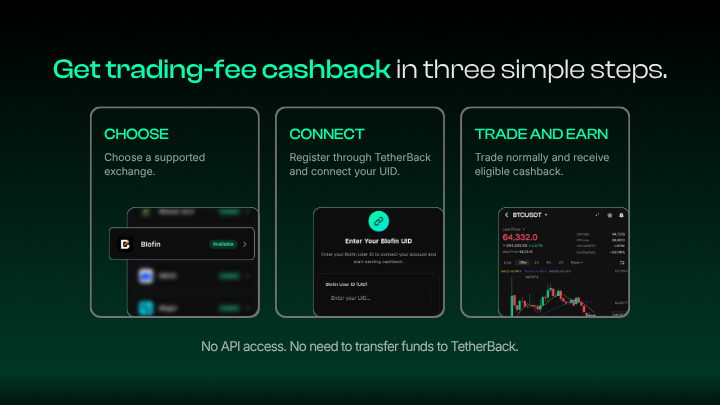
Another effective method is using a structured cashback platform such as TetherBack.
Instead of only lowering the fee rate directly, cashback returns a portion of the fees after you trade. This does not require you to change your strategy or increase your risk.
You continue trading on your chosen exchange. Based on your trading activity and fee generation, a percentage is returned as cashback through the partnership structure.
This method is especially useful for active traders because the more consistent your volume, the more predictable your cashback becomes.
Track Your Real Trading Costs
Many traders focus only on profit and loss but rarely calculate total fees paid over a month.
Tracking fees gives you clarity. When you understand how much you are actually spending, it becomes easier to evaluate whether optimization efforts are working.
You can use tools like the cashback calculator on TetherBack to estimate how much of your trading fees could be returned. Turning percentages into numbers helps you see the impact more clearly.
Combine Strategies for Maximum Efficiency
The most effective approach is not choosing just one method. It combines smart practices.
For example, you might:
-
Use maker orders when possible.
-
Qualify for a reasonable VIP tier.
-
Apply cashback through a platform like TetherBack.
Each method alone may seem small. Together, they can significantly reduce effective trading costs over time.
The key is to improve efficiency without distorting your trading behavior.
What Fee Reduction Cannot Do
It is important to stay realistic.
Lower fees will not fix a losing strategy. They will not remove market risk. They will not guarantee profitability.
What they can do is improve your net result if your strategy already has an edge. When your system is consistent, reducing friction strengthens performance.
Conclusion
Crypto trading in 2026 is competitive. Margins can be tight, especially for active traders.
Reducing trading fees is one of the simplest optimizations available. You do not need a new indicator or a new strategy. You just need to manage costs intentionally.
Understanding fee structures, choosing efficient order types, qualifying for volume tiers, and using cashback platforms like TetherBack are all practical ways to improve long term efficiency.
When you treat fee management as part of your trading framework, you give yourself a measurable advantage.
FAQ
Is reducing trading fees really important?
Yes. Even small percentage reductions can have a meaningful impact over many trades.
Should I increase volume to qualify for lower fees?
Not unless it fits your strategy. Artificially increasing volume can increase risk.
Is cashback better than fee discounts?
They work differently. Fee discounts reduce the rate upfront. Cashback returns part of the fee afterward. Some traders use both.
Do lower fees guarantee profit?
No. Profit depends on strategy and risk management. Lower fees improve efficiency, not outcomes.
About TetherBack
TetherBack is a crypto cashback and rewards platform built for active traders who want to reduce effective trading costs. By partnering with supported exchanges, TetherBack shares a portion of trading fee revenue back to users in the form of cashback.
The platform does not hold user funds and does not operate as an exchange. Traders continue to execute trades directly on their chosen exchange while earning rewards through the partnership structure.
TetherBack focuses on cost efficiency, transparency, and providing traders with a structured way to maximize value from their existing trading activity.